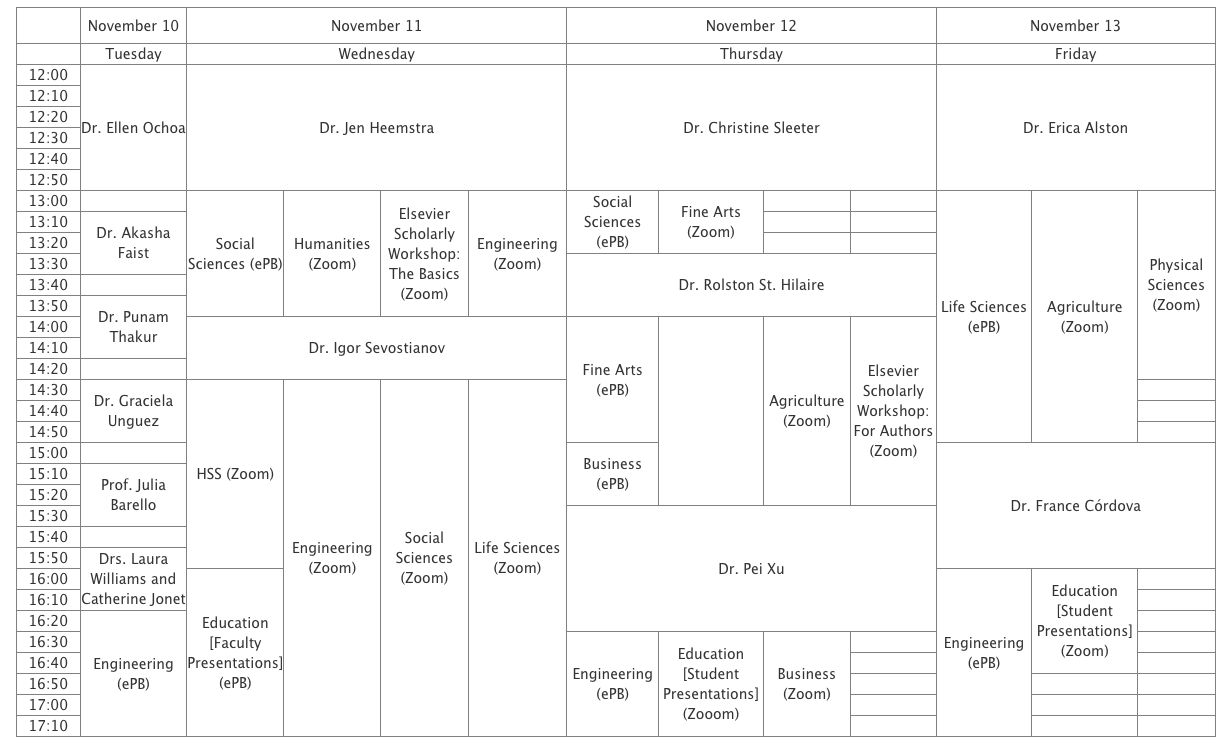
Keynote addresses by featured speakers of 2020
Dr. France Córdova
Friday, November 13, 15:00-16:00 (in ePB Lecture Hall)
Hosted by Chancellor Dan Arvizu
The Future of Science and Technology in the COVID-19 Era
Dr. Ellen Ochoa
Champion of STEM and Diversity: A conversation with Ellen Ochoa, the first Latina in Space
Hosted by Dr. Paulo Oemig
Join us for a fireside chat with Ellen Ochoa, the first Latina in space, and the first Hispanic Director of NASA’s Johnson Space Center, to hear about her career in STEM.
Tuesday, November 10, 12:00-13:00 (in ePB Lecture Hall)
Dr. Jen Heemstra
Wednesday, November 11, 12:00-13:00 (in ePB Lecture Hall)
Hosted by Vice President for Research Dr. Luis Cifuentes
A Scientist's Guide to Social Media
Have you thought about becoming active on social media but not sure where to start? Wondering why it is important and how you might use social media as a researcher? This talk will provide an introduction to social media platforms and focus specifically on how to build and use a presence as an academic researcher on Twitter.
Dr. Christine Sleeter
Thursday, November 12, 12:00-13:00 (in ePB Lecture Hall)
Hosted by President John Floros
The Movement for Ethnic Studies
In this keynote, Christine Sleeter will argue that Ethnic Studies, which has emerged largely from the activism of students of color and their allies, enables students to claim education as useful to their own lives and the lives of their communities. It is, in the words of Manning Marable, “a call toward the systematic reconstruction of American learning.” This reconstruction means challenging institutionalized boundaries defining who can know, who can teach, and what counts as knowledge. She will offer examples of curriculum projects that have broken down those boundaries, and have transformed teaching and learning through Ethnic Studies. She will conclude with a brief look toward the future of Ethnic Studies.
Dr. Erica Alston
Friday, November 13, 12:00-13:00 (in ePB Lecture Hall)
Hosted by President John Floros
Taking the Road Less Traveled -- Finding Your Focus In STEM
Dr. Erica J. Alston from NASA’s oldest field Center, Langley Research Center, will speak about NASA’s mission, NASA’s Office of STEM Engagement and her personal story. She will tout the exciting developments around the Artemis mission that will place the first female on the surface of the moon in 2024. Additionally, she will provide an overview of the program that she helps manage, the National Space Grant College and Fellowship Program, more widely known as Space Grant. Space Grant is the only program within NASA that has awardees and institutions within every state. She will tell her personal story from where she comes from, why she chose STEM, and how she navigated her journey within NASA. She also plans to highlight how students can engage with NASA and will praise efforts of the New Mexico Space Grant Consortium in reaching students across New Mexico.
Dr. Pei Xu
Thursday, November 12, 15:30-16:30 (in ePB Lecture Hall)
Hosted by Provost Carol Parker
Development of Non-traditional Water for National Water Security: Innovative Technologies for Water Reuse and Desalination
Water scarcity and the need to meet the increasing water demands have driven the development of non-traditional water supplies including seawater, brackish water, agricultural, municipal and industrial wastewaters. Given the energy intensity of existing water infrastructures, it is critical to develop sustainable paradigms for water and wastewater engineering that will balance energy consumption, economic benefits, ecological impacts, and social acceptance. This presentation will highlight the research initiatives at NMSU for water security. Innovative technologies for water reuse and desalination will be presented for improving process efficiency, reducing carbon footprint, recovering resources from wastewater, and generating water with quality tailored for various fit-for-purpose applications.
Dr. Graciela Unguez
Tuesday, November 10, 14:30-15:00 (in ePB Lecture Hall)
Hosted by Dr. Brad Schuster
The mental health storm in academia: Are there solutions at NMSU?
Concerns about mental health of undergraduate and graduate students in the research community have been growing in recent years. Surprisingly, there is limited published evidence on the prevalence of mental health among faculty. However, the disruptions caused by COVID-19 and working remotely under quarantine over recent months have sparked conversations on the need to address this health issue on university campuses. This talk is intended to begin this conversation at our campus and share some personal experiences as a researcher, instructor, director of student training and research programs at NMSU and nationally, and community volunteer.
Prof. Julia Barello
Tuesday, November 10, 15:10-15:40 (in ePB Lecture Hall)
Hosted by Dean Enrico Pontelli
Inversions: Phases in a Contemporary Art Practice
Whether it be how Inuit peoples made waterproof coats out of walrus intestine--where garments transition between daily and spiritual life--or vascular studies that examine how what’s under the skin can inform a piece of jewelry; or using the residual markers of people’s interior bodies captured through medical imaging films and transforming their shape and composition into an immersive environment, this talk explores three phases of my career as an artist as they each in turn investigate the relationship between interior and exterior.
Dr. Rolston St. Hilaire
Thursday, November 12, 13:30-14:00 (in ePB Lecture Hall)
Hosted by Dr. Tanner Schaub
Human Dimensions of Efficient Water Use in Residential Desert Landscapes
Plants do not waste water. Humans do! So, a focus on the human factors that drive water efficiency in residential landscapes may provide greatest gain in using water more efficiently in residential landscapes. While, agricultural irrigation is the largest user of freshwater in the United States, increasing urbanization could mean the water used to irrigate the urban landscape will become an increasingly important factor in water conservation strategies. Urban landscape irrigation may not necessarily cause an increase in freshwater withdrawals from existing sources, but the consumptive water of the urban landscape as a proportion of the total consumptive use may increase. In this presentation, I will present research we have conducted at New Mexico State University to unpack the human factors that appear to drive efficient water use in residential landscapes.
Dr. Akasha Faist
Tuesday, November 10, 13:10-13:40 (in ePB Lecture Hall)
Hosted by Dr. Shanna Ivey
Rangeland restoration ecology: identifying and overcoming barriers to restoration success
Ecological restoration, or the act of returning an ecosystem or habitat to a more desirable state, has multiple considerations that must be addressed to improve the efficacy of our actions. We first must understand the basic ecology of an ecosystem to best understand how to put it back together on the landscape. We also know that landscapes are not stagnant and because this is a dynamic process, with environmental conditions fluctuating, our restoration actions must also address this variability. For this presentation, I will discuss how our research lab tackles these considerations to identify creative ways to overcome ecological barriers to rangeland restoration success commonly found across the US southwest
Dr. Punam Thakur
Tuesday, November 10, 13:50-14:20 (in ePB Lecture Hall)
Hosted by Dr. Tanner Schaub
The Importance of Independent (Third Party) Monitoring at the Waste Isolation Pilot Plant
The Waste Isolation Pilot Plant (WIPP) is a transuranic (TRU) waste repository operated by the U.S. Department of Energy (DOE). The repository is emplacing defense-related transuranic (TRU) wastes into a bedded salt formation approximately 655 m (2150 ft.) below the surface of the Earth. Located near Carlsbad, New Mexico, the WIPP facility is licensed to accept defense related transuranic (TRU) and mixed transuranic (MTRU) wastes. The facility recently resumed waste disposal operations following a lengthy recovery process from a February 2014 accident involving a waste container that breached underground. The accident released significant levels of radioactivity into the disposal room and adjacent exhaust drifts and although no one was present in the underground at the time of the release, a total of 22 workers tested positive for very low level of radiation, presumably from some of the radioactive material that was released above ground through a small leak in the HEPA filtration system. WIPP had been a DOE success story, operating nearly 15 years with no significant incidents or accidents.
Many factors contributed to this success, one of the most important being the overwhelming support exhibited by the local community and the local elected officials. One component of the broad public acceptance by the citizens of Southeast New Mexico has been the concept of independent, third party monitoring of environmental effluents at the site conducted by the Carlsbad Environmental Monitoring and Research Center (CEMRC) funded by DOE. Over the years of its existence, the CEMRC’s independence and its extensive monitoring program and public engagement have aided the continuing acceptance of this nearby nuclear facility and has continued to prove its value in terms of assuring continued local acceptance of the facility through a timely dissemination of scientific data. One provides permanent isolation of radioactive materials from the biosphere, and checks itself to assure it is done safely. The other represents an independent check on the degree of safety being provided, and is an advocate for the community in terms of assessing health and safety risks stemming from neighboring WIPP operations. This presentation aims to provide an up-to date overview of environmental monitoring program of CEMRC and the role it plays for the local community in ongoing evaluation of the safety and performance of the facility.
Drs. Laura Williams and Catherine Jonet
Tuesday, November 10, 15:50-16:20 (in ePB Lecture Hall)
Hosted by Dr. Patti Wojahn
Feminist Border Arts: Research-Creation and Curation in Digital and Material Cultures
In How Art Can Be Thought, Allan deSouza remarks that art “might be that which resists definition” (29). It’s “the experience yet to come, the meaning yet unformed, the activity always in process” (29). This presentation examines how Feminist Border Arts, a university-based humanities & arts project, merges research, creation, and curation to produce and circulate new knowledge through practice-based strategies in cinema and video art. Scholar-artist Natalie Loveless calls such formations “an urgent challenge to the reigning pedagogical and research modalities and outputs in the university today” (10). This presentation includes screenings of our two short video pieces, “Speak Near” and “Road” to demonstrate and further explore these modalities.
Dr. Igor Sevostianov
Wednesday, November 11, 14:00-14:30 (in ePB Lecture Hall)
Hosted by Dr. Tanner Schaub
Cross-Property Connections for Heterogeneous Materials and Their Applications
Cross-property connections for heterogeneous materials belong to the realm of fundamental problems of engineering science and physics. They relate changes in different physical properties caused by various inhomogeneities (cracks, pores, inclusions), or, more generally - by the presence of certain microstructure. Their practical usefulness lies in the fact that one physical property (say, electrical conductivity) may be easier to measure than the other (say anisotropic elastic constants). This allows one to bypass difficulties of expressing the elastic properties in terms of relevant microstructural information (that, in addition, may not be available). Such connections are also helpful in the design of microstructures for the combined conductive/mechanical performance and in monitoring of accumulated damage. In the presentation, cross-property connections are specified for several materials currently in the focus of Micromechanics research group.
Topic: Scholarly Publishing Workshop: Learn about the basics of journals publishing
Topic: Scholarly Publishing Workshop: For authors who are looking to understand what journal editors are looking for in submissions for peer review, and anyone looking to get involved in editorial work